
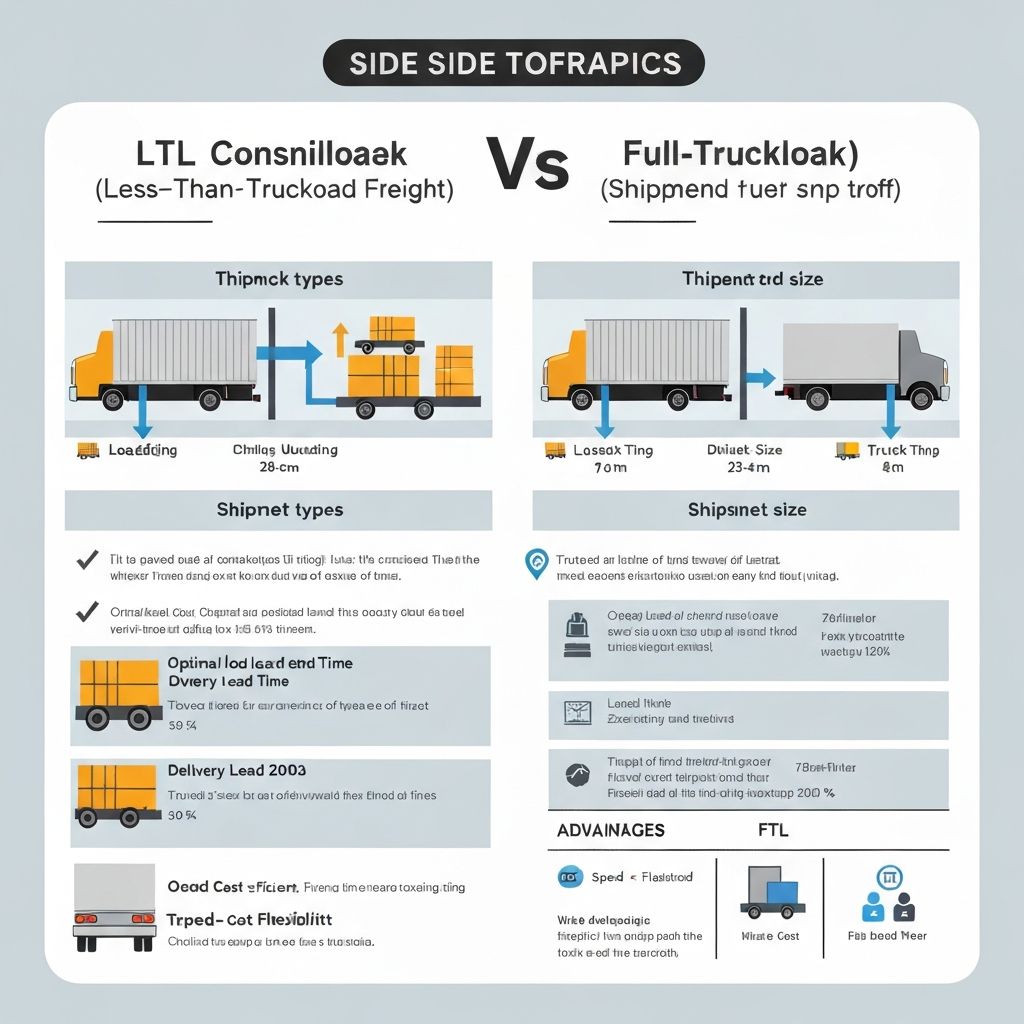
Choosing between Less-Than-Truckload (LTL) and Full Truckload (FTL) shipping is one of the most critical decisions in freight logistics. The wrong choice can cost your business thousands of dollars annually and create unnecessary supply chain delays. This comprehensive guide will help you understand exactly when to use each shipping mode and how to optimize your freight strategy for 2025.
Understanding FTL Shipping: When to Use Full Truckload
Full Truckload shipping dedicates an entire trailer to your shipment, typically ranging from 24 to 26 pallets or 42,000 to 45,000 pounds. FTL is the preferred choice for large shipments that can fill most of a trailer's capacity.
Key Benefits of FTL Shipping
Direct routing is the primary advantage of FTL. Your freight travels directly from origin to destination without stops at intermediate terminals. This means faster transit times and significantly reduced handling, which translates to lower damage rates.
Cost efficiency at scale makes FTL economical for larger shipments. When your freight exceeds 10,000 pounds or fills more than half a trailer, FTL often costs less per pound than LTL alternatives.
Simplified tracking with FTL means you always know where your shipment is. There is no consolidation or deconsolidation, so tracking is straightforward and accurate.
When FTL Makes Sense
- Shipments exceeding 10 pallets or 10,000 pounds
- Time-sensitive deliveries requiring guaranteed transit
- High-value or fragile goods needing minimal handling
- Consistent large-volume shipping lanes
Understanding LTL Shipping: Maximizing Efficiency for Smaller Loads
Less-Than-Truckload shipping consolidates multiple shippers' freight onto a single trailer. This shared model makes professional freight transportation accessible for shipments ranging from 150 to 10,000 pounds.
How LTL Pricing Works
LTL carriers use the National Motor Freight Classification (NMFC) system to determine rates. Your freight class, based on density, stowability, handling requirements, and liability, directly impacts your shipping costs.
Dimensional weight calculations mean that low-density shipments may cost more than their actual weight suggests. Understanding how to optimize packaging can significantly reduce LTL expenses.
Advantages of LTL Shipping
Lower costs for smaller shipments is the obvious benefit. You only pay for the trailer space your freight occupies, making LTL ideal for businesses without full truckload volumes.
Flexible scheduling allows you to ship when ready without waiting to accumulate enough freight to fill a trailer. This improves inventory management and cash flow.
Accessorial services like liftgate delivery, inside delivery, and appointment scheduling are standard LTL offerings that support diverse delivery requirements.
Cost Comparison: Real-World Examples
Understanding the financial implications requires looking at actual scenarios:
Scenario 1: 4 Pallets, 2,500 lbs, Chicago to Atlanta
- LTL: $850-1,100 depending on freight class
- FTL: $1,800-2,200 (paying for unused capacity)
- Winner: LTL by 50-60%
Scenario 2: 18 Pallets, 32,000 lbs, Los Angeles to Dallas
- LTL: $4,500-5,500 with multiple handling points
- FTL: $2,800-3,400 direct routing
- Winner: FTL by 35-40%
Scenario 3: 8 Pallets, 8,000 lbs, New York to Miami
- LTL: $1,600-2,000
- FTL: $2,400-2,800
- Decision point: Consider partial truckload options
The Hybrid Approach: Partial Truckload and Consolidation
Smart shippers increasingly use hybrid strategies to optimize costs:
Partial truckload (PTL) fills the gap between LTL and FTL, typically for shipments of 6-18 pallets. PTL offers better rates than LTL with fewer handling points than traditional consolidation.
Pool distribution consolidates multiple shipments to a region, then distributes locally. This combines FTL linehaul efficiency with last-mile flexibility.
Dedicated lanes with consistent volume can negotiate contract rates that outperform both spot LTL and FTL pricing.
Decision Framework: 5 Questions to Ask
Before booking any shipment, answer these questions:
-
What is the total weight and pallet count? Over 10,000 lbs or 10 pallets typically favors FTL.
-
How time-sensitive is the delivery? Urgent shipments benefit from FTL's direct routing.
-
What is the freight's value and fragility? High-value goods may justify FTL's reduced handling even at smaller volumes.
-
Is this a consistent lane or one-time shipment? Regular volume opens contract pricing opportunities.
-
What accessorial services are needed? Complex delivery requirements may favor LTL's service options.
2025 Market Trends Affecting Your Decision
Several factors are reshaping the LTL vs FTL calculus:
Capacity fluctuations continue as carriers adjust fleet sizes. FTL spot rates remain volatile, while LTL carriers have implemented more consistent pricing structures.
Technology integration now enables real-time rate shopping across modes. Platforms can automatically recommend the optimal shipping method for each shipment.
Sustainability requirements are driving consolidation. Shippers face pressure to maximize trailer utilization, benefiting both LTL networks and FTL optimization.
Partner with Freight Experts
At Portlandia Logistics, our freight solutions team analyzes your shipping patterns to identify optimization opportunities. We leverage relationships with 75,000+ carriers to secure competitive rates across LTL, FTL, and partial truckload options.
Contact our team at (502) 385-3399 or request a quote to discover how much you could save with an optimized freight strategy.
Frequently Asked Questions
What is the weight threshold for choosing FTL over LTL?
The general rule is 10,000 pounds or 10 pallets, but this varies by lane and market conditions. Shipments between 6,000-12,000 pounds often fall into a gray zone where detailed rate comparison is essential. Consider factors beyond weight including freight class, distance, and transit time requirements when making your decision.
How does freight class affect LTL shipping costs?
Freight class ranges from 50 to 500, with lower classes indicating denser, easier-to-handle freight that costs less to ship. Class is determined by four factors: density (pounds per cubic foot), stowability, handling requirements, and liability. A freight class miscalculation can result in reweigh fees and unexpected charges, so accurate classification is critical.
Can I negotiate LTL rates like FTL contract rates?
Yes, shippers with consistent LTL volume can negotiate contracted rates with carriers. These agreements typically require minimum monthly shipment counts or revenue commitments. Even without formal contracts, working with a freight broker provides access to volume-discounted rates across multiple carriers.
What is partial truckload and when should I consider it?
Partial truckload (PTL) services handle shipments typically between 5,000-35,000 pounds or 6-18 pallets. PTL offers fewer handling touchpoints than LTL with more competitive pricing than booking full truckload capacity you won't use. Consider PTL when your shipment exceeds standard LTL pricing thresholds but cannot justify full trailer costs.
How do fuel surcharges differ between LTL and FTL?
LTL fuel surcharges are calculated as a percentage of linehaul charges, typically ranging from 25-35% depending on diesel prices. FTL fuel surcharges are usually calculated per mile, currently averaging $0.50-0.70 per mile. When comparing total costs, always factor in fuel surcharges as they significantly impact the final price, especially on longer hauls.
Related Topics
Jennifer Rodriguez
Freight Solutions Manager
With over 15 years of experience in logistics and supply chain management, Jennifer brings deep industry expertise to help businesses optimize their freight operations.